
Dune Bashing for Beginners: Where to Go and How to Prepare in the UAE
A beginner’s guide to dune bashing in the UAE: when to go, tyre pressures, driving technique, safety rules, what to pack and beginner-friendly desert areas.

What to do when your 4x4 gets stuck in soft sand: stop spinning, lower tyre pressure, dig and use recovery boards, and how to do a snatch recovery safely.
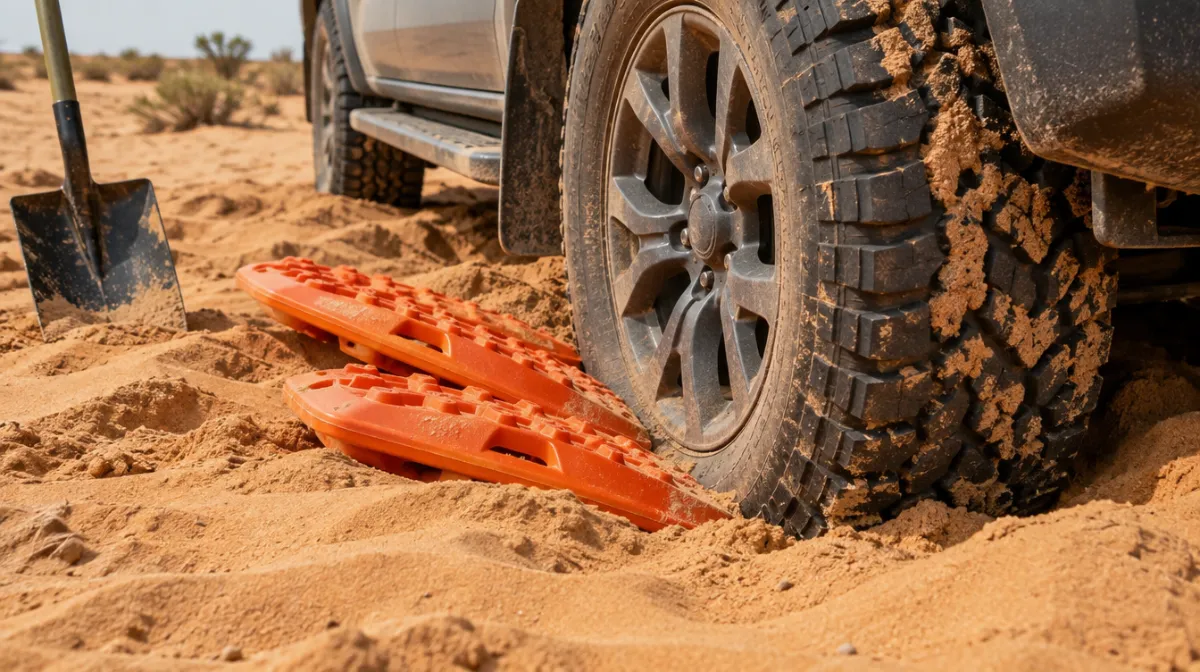
Everyone gets stuck in the desert. The difference between a two-minute delay and a broken vehicle or injury is what you do next. Work through these steps in order, from the gentlest method to the most forceful.
As soon as forward progress stops, ease off the throttle. Spinning wheels dig holes, bury the axles and overheat the clutch or transmission. Put the vehicle in neutral or park, keep the engine running for air conditioning if it’s hot, and get out to look.
Check what’s stopping you: are the wheels dug in, or is the chassis resting on sand? Look at the slope. Reversing downhill along your own tracks is almost always easier than pushing on uphill. Radio your convoy so others don’t crest the dune behind you.
Letting out more air lengthens each tyre’s footprint and can be enough on its own. If you were already at sand pressures, go a few psi lower for the recovery, then re-inflate once you’re moving on firmer sand. Very low pressures risk rolling a tyre off its rim, so drive gently.
Dig away sand in front of all four tyres, making a gentle ramp in the direction you want to go. Clear any sand packed under the chassis, axles and sills. Straighten the front wheels: turned wheels plough.
Engage low range and, where fitted, lock the centre differential. Use a low gear and smooth, steady throttle. Many drivers find reversing out along their tracks works best. If the wheels spin again, stop straight away and go back to digging.
Wedge recovery boards firmly against the front of the tyres, or behind them if reversing, and drive slowly onto them. Don’t let the wheels spin on the boards, and keep people well away: boards can fly out from under tyres.
If you still can’t move, get help from another vehicle.
| Method | When to use it | Key rules |
|---|---|---|
| Static tow strap | Gentle, steady pulls on firmer ground | Pull slowly; no jerking |
| Kinetic recovery rope | Deeply stuck in soft sand | Rated points only; experienced operators |
| Winch | No second vehicle can get close, or steep ground | Use a damper; stand clear |
Our desert recovery gear checklist covers what to carry, and our winch buying guide explains how to choose and use a winch.
New to all of this? Start with our dune bashing guide for beginners.
Stay with the vehicle: it’s shade, shelter and far easier for rescuers to spot than a person walking. Drink water, keep out of the sun and call 999, sharing your GPS location.
Often, by lowering tyre pressure, digging and using recovery boards. That’s why you should carry them even when driving in a convoy.
Pushing from behind or the sides can cause injuries if the vehicle suddenly moves or slides. Use boards and gentle throttle instead.
Using the wrong attachment points. Broken tow balls and shackles have caused serious injuries and deaths.

Every article is edited by a human and checked against our editorial policy. Spotted a mistake? Tell us.
A beginner’s guide to dune bashing in the UAE: when to go, tyre pressures, driving technique, safety rules, what to pack and beginner-friendly desert areas.
The best off-road areas within reach of Dubai, from Big Red and Fossil Rock to the red dunes near Lahbab, with difficulty levels, access rules and safety tips.
A 4x4 driver’s guide to the Liwa desert: when to go, getting there, the scale of the dunes, fuel and supplies, convoy rules, camping and staying safe.